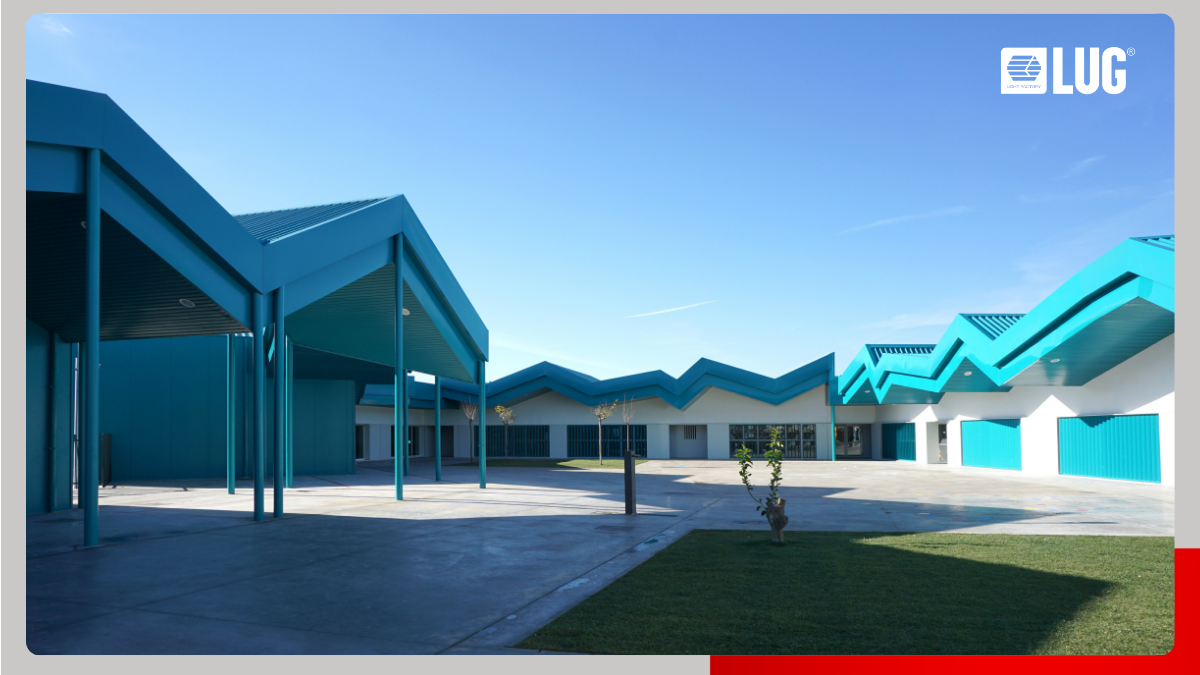
The anatomy of school fatigue. How light affects pupils
The human body follows a circadian rhythm closely linked to natural daylight. In the morning, we need bright, cooler light that helps suppress melatonin, the sleep hormone, and supports the production of cortisol — the hormone associated with alertness and activity.
In many schools, however, two lighting scenarios are still common:
Old, flickering fluorescent lighting with a yellowish tone, sending the brain the message: “It is evening, time to wind down.”
Harsh, monotonous lighting that remains the same throughout the day, causing glare and constant eye strain.
The result? Pupils spend hours fighting their own biology. Instead of focusing fully on physics, maths or languages, their bodies are using energy simply to stay alert.
Modern lighting systems make it possible to adjust both colour temperature and light intensity according to the task being carried out:
Focus mode, around 5000 K - cooler, more intensive light for tests, demanding topics or morning lessons. It can help support concentration and alertness.
Relax mode, around 2700 K–3000 K - warmer, dimmed light for group work, discussion, calming down after PE or creating a more relaxed atmosphere.
School leaders and local authorities often look at lighting upgrades mainly through the lens of cost. However, replacing outdated lighting with intelligent LED systems, supported by daylight sensors and controls, can reduce electricity bills significantly.
More importantly, good lighting can help create better learning conditions. Research into classroom lighting indicates that appropriate lighting can reduce the number of mistakes made by pupils and improve reading speed. In practice, this means lighting should be treated not only as a technical installation, but as part of the learning environment.
Today’s school is much more than a set of classrooms. It is a complex building that includes teaching rooms, ICT suites, laboratories, common rooms, corridors, toilets, staff rooms, sports halls and external areas. Each of these spaces has a different purpose, a different level of use and different lighting requirements.
That is why modernising school lighting should never be treated as a simple like-for-like replacement of old luminaires. It is a technical design process that affects learning comfort, user safety, energy efficiency and the ongoing cost of maintaining the building.
Well-designed lighting supports concentration, improves visibility, reduces visual fatigue, helps people navigate the building more easily and enables more effective energy management across the site.
One of the most common mistakes in lighting upgrades is treating the whole school as one uniform environment. In reality, every zone requires its own design approach.
In practice, this means that:
classrooms require uniform lighting, good glare control, accurate colour rendering and clear illumination of boards,
ICT suites need lighting that minimises reflections and glare when working with screens,
vocational training rooms must take into account not only lighting performance, but also the resistance of luminaires to moisture, dust and more demanding operating conditions,
common rooms and craft rooms need flexible lighting suitable for learning, play, manual work and rest,
corridors and circulation areas are essential for safety, wayfinding and user comfort during breaks,
sports halls require high luminous flux, good uniformity, robust luminaires and solutions designed for intensive use.
Good school lighting is not about installing one type of luminaire throughout the whole building. It is about matching the light to the function of each individual space.
When designing lighting for education settings, it is not enough to look only at luminaire wattage. The key parameters are those that directly affect visual comfort, safety and the quality of the space.
The most important include:
maintained illuminance - matched to the function of the room and the tasks carried out there,
uniformity - reducing shadows, excessive contrast and underlit areas,
UGR - the Unified Glare Rating, particularly important in classrooms, ICT rooms and staff rooms,
CRI - the Colour Rendering Index, important for learning, practical work, laboratories and administrative areas,
colour temperature - influencing how the space is perceived and how comfortable it feels,
flicker control - important for reducing visual fatigue,
durability and electrical safety - especially important in buildings used intensively by children and young people.
In education buildings, lighting should be designed in line with applicable standards, but also with a clear understanding of how the building is actually used day to day.
LED technology offers schools clear benefits: lower energy consumption, longer service life, reduced maintenance costs and the ability to control light more effectively. However, simply replacing old lamps or luminaires with LED products does not automatically guarantee better lighting quality.
The greatest value comes from a structured modernisation process:
audit of the existing installation,
analysis of room functions,
selection of luminaires for specific zones,
lighting calculations,
consideration of daylight contribution,
lighting controls design,
installation and commissioning,
final measurements and handover checks.
Without this approach, it is easy to reproduce the same problems as before: poor uniformity, excessive glare, insufficient board lighting, reflections on screens or unsuitable lighting levels in key areas.
In school buildings, lighting operates for many hours each day, often across a large number of rooms at the same time. This means the potential for energy savings is particularly important, especially where older fluorescent luminaires are still in use.
Energy consumption is mainly influenced by:
the wattage of each luminaire,
the number of luminaires,
operating hours,
energy cost,
how each room is used,
the presence of controls and sensors.
In sports halls, common rooms, corridors and toilets, the benefits come not only from LED technology itself, but also from the ability to reduce lighting output when full illumination is not required. That is why it is worth considering:
motion sensors,
zoning of the installation,
daylight harvesting,
lighting scenes,
operating schedules.
Modern lighting should not only be efficient. It should operate when needed, where needed and at the right intensity for the specific space.
Luminaire selection should always be based on the lighting design and the function of the room. The LUG portfolio includes solutions that can be adapted to different areas within an education building.
Classrooms
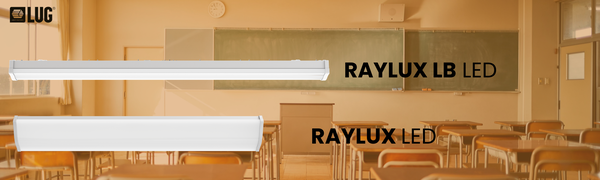
In standard teaching spaces, linear luminaires such as RAYLUX and RAYLUX LB are a strong choice. They help achieve uniform lighting and can be arranged to suit the classroom geometry and desk layout.
ICT suites
In rooms with monitors, glare control and the reduction of screen reflections are critical. Panel-type solutions such as LUGCLASSIC SLIM are a good direction for supporting comfortable visual work.

Vocational training rooms
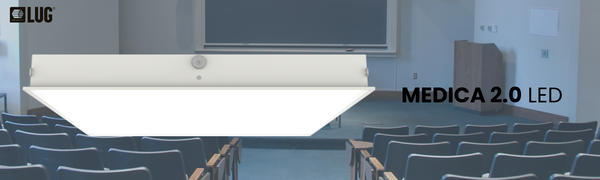
In areas exposed to more demanding operating conditions, luminaires should be selected not only for their lighting performance, but also for their environmental suitability. MEDICA 2.0 is an example of a solution that can be used in such applications.
Common rooms and craft rooms
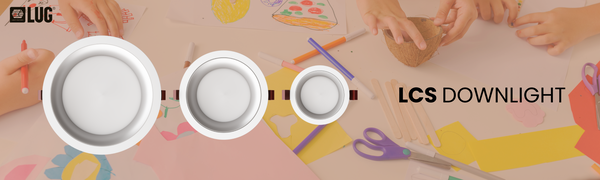
In multifunctional spaces, downlight solutions such as LCS DOWNLIGHT can work well. They are suitable where lighting needs to support a range of activities: learning, play, rest and practical work.
Sports halls
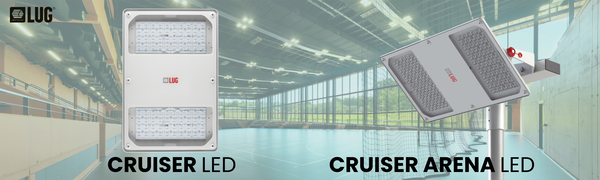
In large sports spaces, high luminous flux, durability and energy efficiency are key. CRUISER is an example of a solution designed for these types of applications.
Modernisation as a strategic decision
School lighting is increasingly becoming part of a wider strategy for upgrading public-sector buildings. For school managers, it means better conditions for learning and work. For local authorities, it means a real opportunity to reduce operating costs. For designers and contractors, it means combining regulatory, technical and user requirements into one coherent solution.
The regulatory context is also important. Restrictions affecting T5, T8 and CFL fluorescent lamps are accelerating modernisation decisions and show that the move to modern LED systems is not only about energy savings. It is also about preparing building infrastructure for technological and regulatory change.
Lighting in education settings should be safe, comfortable, energy-efficient and tailored to the function of each space. It should support learning in classrooms, screen-based work, practical lessons, rest in common rooms, activity in sports halls and safe movement around the building.
That is why lighting modernisation should be planned as a complete process — from audit and design, through luminaire selection, to final measurements and as-built documentation. Only then does LED technology become a real tool for improving the quality of educational spaces.
LUG supports investors, designers, contractors and local authorities in creating lighting solutions tailored to the needs of schools, nurseries, early-years settings and other education buildings. If you are planning a lighting upgrade in an education facility, the right place to start is with an analysis of zones, requirements and energy-saving potential.
Good lighting does not replace good education. But it can create the conditions in which learning, work and safety all perform at a higher level.
CONTACT Request a complimentary audit.